Here’s what most wedding toast guides get wrong: they assume the hardest part is knowing what to say. For siblings, that’s usually not the problem. You have more material than almost anyone else in that room. You were there for the whole story—the kid, the teenager, the phases nobody else witnessed, the character-revealing moments that happened long before the person they’re marrying came along.
The real challenge is figuring out how to use it. How to take a lifetime of knowing someone and compress it into three minutes that actually land.
That’s what this guide is for.
What a sibling toast is (and isn’t)
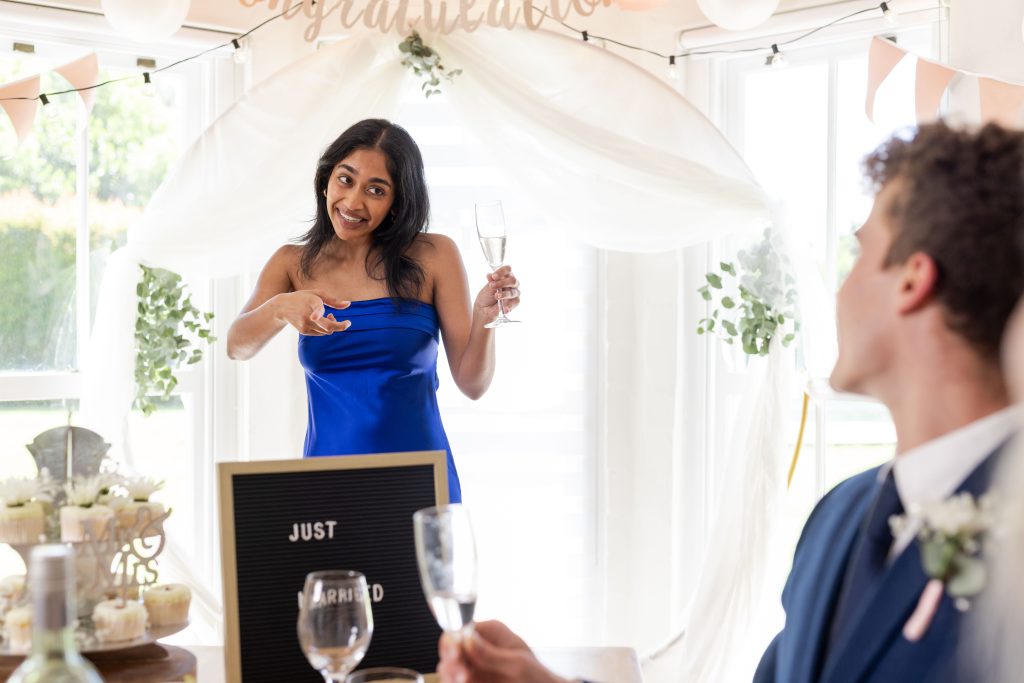
The traditional wedding speech lineup—father of the bride, best man, maid of honor—is increasingly flexible. Couples regularly include siblings now, either at the reception or at the rehearsal dinner, which is often the better setting for a more personal, longer toast.
A sibling wedding toast occupies a specific emotional register. It’s more personal and emotionally loaded than a best friend’s speech. It’s less formal than a parent’s. You have the lifetime of experience that parents have, but you’re also their contemporary. Someone who grew up alongside them, not above them.
That distinction matters for how you write it.
On length: three minutes is the sweet spot for a sibling speech at a wedding. Five minutes is the absolute ceiling. If the rehearsal dinner is your venue, you have a bit more room. The setting is more intimate and the schedule is less rigid. At the reception, stay tight.
The advantage you actually have
Before you sit down to write, it helps to understand what you’re working with.
A best man has known the groom for years. A sibling has known them their whole life. That’s not a minor difference. You have access to the “before” version of this person. Who they were before anyone at that wedding knew them.
You were there for the moments that shaped them. You saw them handle failure, fall out with people, grow into themselves slowly and sometimes painfully.
You also have something nobody else has: the specific moment you noticed they were different around this person. The goofy smile they tried to hide. The text you got at 11pm. The behavior you’d never seen before.
That material, if you use it specifically, is what separates a wedding speech for a sibling that people remember from one they politely applaud.
The job is to use what you have. Not “he’s the most loyal person I know.” The moment that proves it. Not “I could tell she had changed.” What you actually saw.
The structure that actually works
A sibling wedding toast doesn’t need to be complicated. It just needs to move in the right direction.
Introduce yourself briefly. Not everyone in that room knows you. Your name, your relationship to the couple, how long you’ve known them. Two sentences. That’s all the introduction you need.
One childhood memory that reveals character. This is where you have an advantage nobody else does. Pick one specific memory. Not their best moment, a real one. Something that shows who they actually are. Keep it short and concrete.
The moment you knew this partner was different. This is the emotional center of the speech. Not “I knew they were meant for each other.” That’s generic. The specific thing you saw, heard, or noticed that told you this was different. A concrete detail is worth ten general impressions.
What you love about the couple together. One real observation. Something you’ve actually witnessed over time. Not a compliment you’d give about any couple, but something specific to these two people in this particular relationship.
Welcome the new partner into the family. This is important and often skipped. You were asked to toast a couple, not just your sibling. Find something genuine to say about the person they’re marrying. What you’ve seen in them, what you admire. “They make my sibling happy” is weak. Show the evidence.
One genuine wish for their future. Brief. Real. Not a greeting card sentiment.
The close and raise. Invite everyone to raise their glass. This is the one line worth memorizing. Deliver it with your eyes up, glass high.
How to adjust for your specific relationship
The structure above is a framework, not a script. How you use it depends on the dynamic you actually have.
| Relationship | Pro tip |
| Older sibling toasting younger | Three snapshots (kid, teen, adult). Let them shine. |
| Younger sibling toasting older | Admiration + humor poking fun at the sibling. End with something real. |
| Sister toasting brother | Protective handoff. Show *why* you trust this partner with specificity. |
| Brother toasting sister | Quiet gatekeeper finally saying yes. Vulnerability beats jokes. |
| Siblings not always close | Acknowledge the real dynamic. Find what stayed true despite distance. |
Older sibling toasting a younger sibling:
Your natural territory is protective pride. You watched them grow up, and now you’re watching them step into something new. A good approach is the “three snapshots”: the kid, the teenager, the person they are today. Each stage sharp and specific, with the partner as the natural next chapter. Be careful not to be condescending. The goal is to let them shine, not to position yourself as the one who made them who they are.
Younger sibling toasting an older sibling:
This is often more reverential. Things you’ve always admired but never actually said out loud. It’s also good territory for humor, because the younger sibling finally getting to poke fun at the older child is a dynamic most families recognize. Use that. Just end somewhere real.
Sister toasting a brother:
The protective handoff is a natural angle here. You’ve been the one looking out for him, and now you’re passing that job to his partner. When it’s done with specificity and genuine feeling, this lands hard. The key is showing why you trust the handoff, not just that you do.
Brother toasting a sister:
Usually a mix of pride and teasing. The challenge for brothers is letting the vulnerability show. The one who was quietly evaluating every partner, and what it means to finally say yes to this one. That’s more interesting than the jokes.
Siblings who weren’t always close:
This deserves an honest mention. Pretending a distant relationship was close reads as fake—and the couple knows it better than anyone. Acknowledging the real dynamic, and what remained true despite the distance, is often more powerful than manufactured warmth. Earning the sentiment is better than performing it.
What it actually sounds like (Examples)
Here are five short examples across different tones and dynamics. These aren’t full speeches. They’re the kinds of passages that make a sibling toast memorable. Use them as a reference for what specificity and honesty actually sound like.
Example 1: The protective handoff (Sister to brother)
Warm, emotional. Best for an older sister who’s always been the one looking out for him.
“For as long as I can remember, looking out for Jamie was just part of my job description. I drove him to school when he missed the bus. I scared off two girlfriends I didn’t think were good enough. I called him every Sunday, mostly to make sure he was eating actual food and not just protein bars and optimism. And then he met Cara. The first time I saw him around her—really saw them together—I noticed something I hadn’t seen before. He was calm. Not performing, not managing, just calm. And I thought: okay. My shift is over. Not because I stopped caring, but because she clearly already does it better than I ever could. Cara, welcome to the job. You’re doing great.”
Example 2: The moment you knew (Any dynamic)
Works for any sibling combination. The specific observation is everything.
“I knew something was different the night Marcus texted me after their third date. He doesn’t text me about dates. He never has. Not in 30 years. But at 11:30 on a Tuesday he sent me a single message: ‘I think she’s it.’ I didn’t respond right away. I just read it twice and smiled, because I’d been waiting a long time to get that text. Tonight, watching them up there, I can confirm he was right.”
Example 3: The three snapshots (Older sibling to younger)
Natural arc, works well when the age gap is significant.
“I’ve known Priya her whole life. I remember her at seven, convinced she could negotiate her bedtime if she just presented a compelling enough argument. I remember her at sixteen, furious at the world and somehow still the first person anyone called when something went wrong. And I know her now. This woman standing in front of all of us today, who built something really remarkable. Each version was unmistakably her. And Dani, what I want you to know is that you get all of it. The seven-year-old logic, the teenage fire, and the person she became. That’s the deal. Welcome to our family.”
Example 4: Younger sibling finding their voice (Younger to older)
Light humor with a real landing. Best for a younger sibling who grew up in their shadow.
“Growing up, I lived in my brother’s shadow. He was better at sports, better at school, better at the whole ‘being a person’ thing in general. For a long time I thought it was just genetics. But then I started watching how he treats Sofia. How patient he is, how he actually listens, how he shows up even when it’s inconvenient. And I realized something. He wasn’t just born like this. He chose to be like this. Which means the rest of us have no excuse. Ryan, I have spent twenty-six years learning from you without ever admitting it. Consider this my admission. And Sofia, thank you for making him so easy to look up to.”
Example 5: Siblings who weren’t always close
Honest about distance. The warmth is earned, not performed.
“Lena and I didn’t grow up close. We were different people, we went different directions, and for a while there we were more polite than we were real with each other. But some things don’t require proximity to stay true. I always knew she was someone worth knowing. I just hadn’t done the work to show it. When she introduced me to Greg, something shifted. Watching her with him—watching how she lets herself be known by him—I understood that she’d found something I wanted her to have. Lena, I’m so glad you did. And Greg, I’m sorry it took me this long to say it out loud: she’s one of the best people I know, and I’m proud to call you family.”
A few practical notes before you write
- Start at least a month out. Give yourself time to come back to it with fresh eyes.
- Write it down fully. Don’t plan to wing it. Multiple wedding professionals flag this as the most preventable mistake they see. Nerves and emotion will eat your words. Put them on paper.
- Read it out loud as you draft. A sentence that looks fine on a page can feel stiff or unnatural when you speak it. Write and read at the same time.
- Practice three to five times before the day. Not to memorize it, just to get comfortable. By the third read-through, you’ll know the shape of it well enough that a glance at your notes is all you need.
- Bring a physical copy. Paper beats phone. Write it in a large, readable font. If you feel yourself getting emotional during practice, that’s a good sign. It means the material is right. Just know where those moments are so you can pace yourself.
You’re not the only one with something to say
A sibling toast gives you three minutes. But what you know about your brother or sister, the whole history of it, doesn’t fit in three minutes. And you’re not the only person in that room with something worth saying to the couple.
There are friends who flew in for this. Relatives who’ve been waiting years to say something out loud. People who’d never ask for a microphone but absolutely have something real to give.
If you want to give the couple something that goes beyond your toast, tell them about The Toast.
The Toast creates a professionally edited wedding video keepsake built entirely from messages their guests record before the wedding, on the day, or both. No public speaking required. Simple prompts, a phone camera, and we handle the rest. The couple ends up with something they’ll come back to long after the wedding day. Everyone’s version, not just yours.