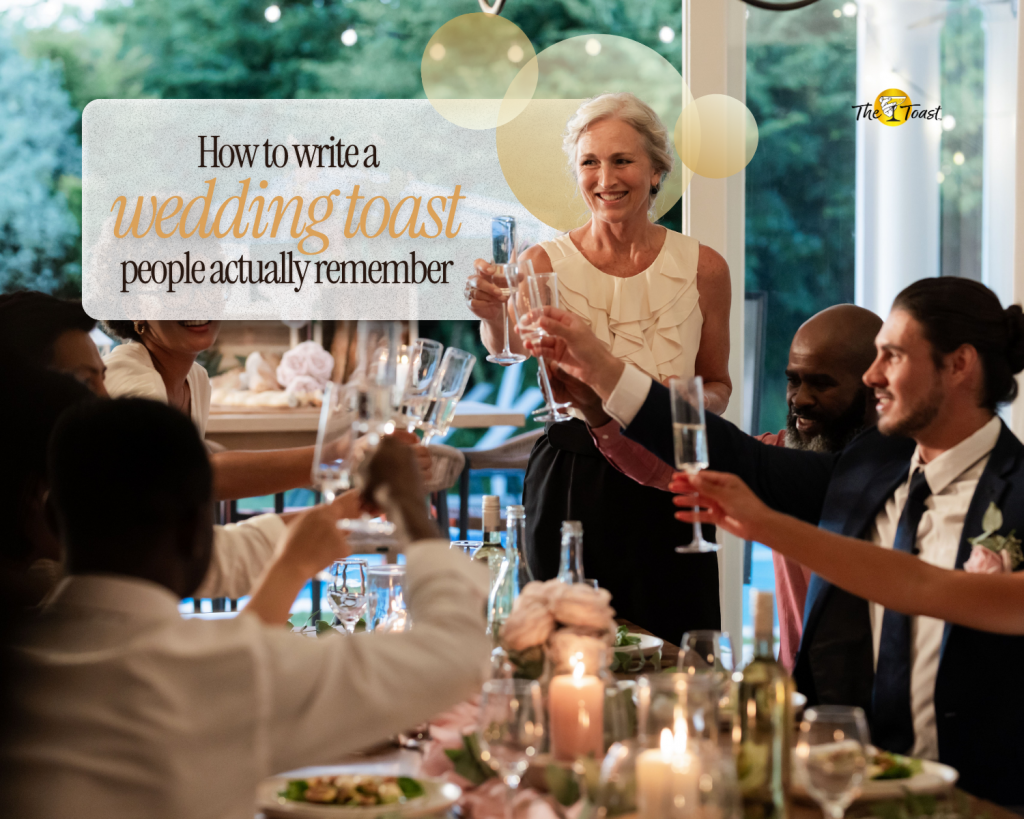
You’ve been asked to give a toast. Maybe you said yes immediately, maybe you panicked a little first. Either way, you’re now the person standing between a roomful of people and their dinner, holding a microphone, with everyone looking at you.
No pressure.
Here’s the good news: you don’t need to be a great writer or a natural public speaker to nail this. You just need a clear structure, one good story, and the sense to know what to leave out. This guide covers all of it.
First, understand what a wedding toast actually is
People use “wedding toast” and “wedding speech” interchangeably, but they’re not quite the same thing.
A toast is short, focused, and ends with a raised glass. A speech is longer and more narrative. In practice, most reception toasts land somewhere in between—personal stories, a few genuine wishes, and then everyone drinks.
Knowing this helps you calibrate. You’re not writing a TED talk. You’re not delivering a roast. You’re honoring two people in front of everyone they love, and then sitting back down.
Who typically gives toasts: the best man, maid of honor, and parents. Sometimes the couple themselves. Anyone else who wants to speak should check with the couple or coordinator first. Surprise toasts don’t always land the way you’d hope.
When they happen: usually after dinner begins and before the dance floor opens. The evening has a schedule, and your toast is part of it.
How long: two to three minutes for most speakers. Up to five for the best man or maid of honor. More on this below.
The structure that actually works
| The 2-minute wedding toast formula | ||
| Section | Content focus | Strategic goal |
| The hook | A specific opening line or observation | Earn the room’s attention in the first 30 seconds |
| The evidence | One personal story that “shows” character rather than listing adjectives | Give the room indisputable proof of why this couple belongs together |
| The bridge section | Connecting that story to the couple’s shared future | Transition from a personal anecdote to the emotional heart of the day |
| The raise | A simple, genuine wish for the couple | Signal the end of the toast and invite the room to celebrate |
A good wedding toast doesn’t need to be complicated. It just needs to move in the right direction.
- The hook. The first 30 seconds either earn the room’s attention or lose it. Don’t open with “for those of you who don’t know me.” It’s a time-waster that divides the room into categories nobody asked for. Instead, jump straight into something specific. A quick observation, a one-liner, or the first line of a story. Make people lean in.
- Your intro. Once you have the room, tell them who you are and why you’re speaking. Two sentences. That’s all you need.
- The story. This is the heart of the toast. One personal, specific anecdote that says something true about the person or the couple. Not “she’s the most generous person I know.” The moment that proves it. We’ll go deeper on this in the next section.
- The bridge. After the story, connect it. What does it tell us about why this couple works? What have you seen in their relationship that you want the room to know? This is where the emotional weight lands.
- The close and raise. A genuine wish for their future, then invite everyone to raise their glass. Keep it simple. This is the one line worth memorizing so you can deliver it with your eyes up, glass high, and a smile on your face.
The story is the whole thing
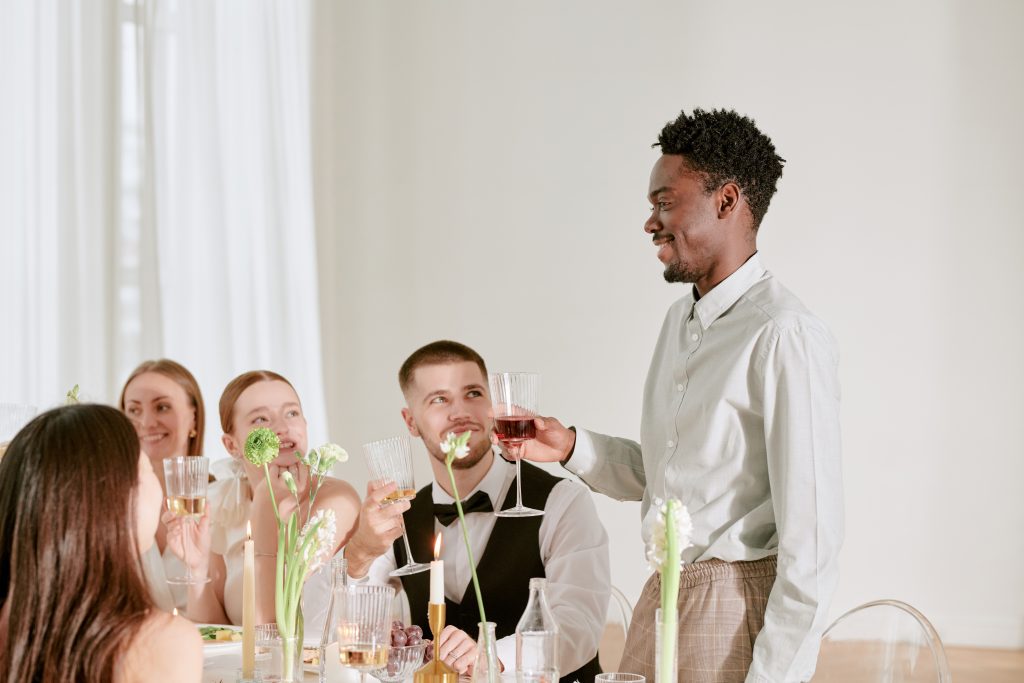
Here’s what separates a wedding toast people remember from one they politely applaud and immediately forget: the story.
Not a list of qualities. Not “she’s kind, funny, and the best friend I’ve ever had.” Those are adjectives. They sound nice, and they mean nothing. What you need is one moment—specific, clear, and true—that shows the room something real about this person or this couple.
Emmy-winning comedy writer Beth Sherman describes it this way: don’t tell us the groom loves the bride “so much.” Give us indisputable evidence.
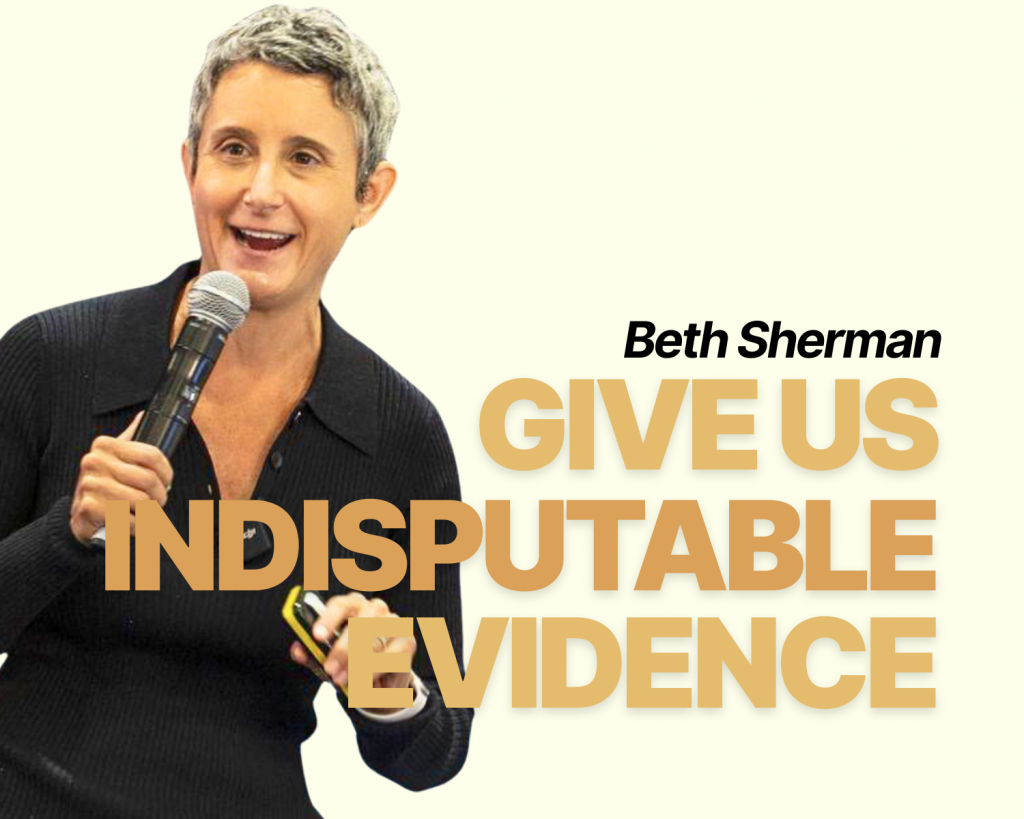
Her example: a groom who slept with an EpiPen under his pillow because his bride has three cats and he’s violently allergic to them. That’s love. That’s a story.
Your story doesn’t have to be that dramatic. It just has to be yours.
But if you’re someone who doesn’t know the couple as well—maybe you’re toasting on behalf of a family, or you’re closer to one half of the pair than the other—don’t panic.
Sometimes the best way to find your angle is to start small. Think about the one word you’d use to describe them. The moment you first understood what made them good together. The thing you’d want their kids to know about them someday.
That’s actually the thinking behind how The Toast approaches guest messages. Instead of asking people to come up with something from scratch, guests receive simple prompts. Things like “Describe the couple in three words.” This makes it easy for anyone to say something real. Sometimes a simple question is all it takes to unlock something worth saying.
How to find it:
Go back through old photos and videos. Think about a moment that made you understand who this person really is. Not their best moment necessarily, but a real one.
Look for something that reveals character. A decision they made, how they showed up for someone, the way they act when nobody’s watching.
What makes it work:
It’s specific enough that only you could tell it. It’s inclusive enough that the whole room can follow it. No unexplained inside references, no context that only five people at your table have.
And it connects back to the couple, not just to your friendship with one of them. The best stories loop back around: here’s what I saw, and here’s what it tells me about why these two people belong together.
What makes it fall flat:
Making yourself the main character. Using it as a vehicle for an inside joke that half the room doesn’t get. Or—the most common version of this mistake—spending the entire toast on the person you know well and barely mentioning their partner. You were asked to toast a couple, not your best friend. Find something genuine to say about both of them.
What to include (and what to leave out)
Include:
Your real connection to the couple.
Don’t perform emotion, just be honest about it. Something specific about each person, or about what makes them work together.
Humor, if it comes naturally to you. And a genuine wish for their future that doesn’t sound like it came from a greeting card.
Leave out (and this list is non-negotiable):
Exes. Hard no. Even framed positively (“I’m so glad he didn’t end up with…”) it creates a moment nobody asked for.
Embarrassing stories. If you’re pausing to wonder whether it’s appropriate, it isn’t. Cut it.
Inside jokes without context. If you’re going to include one, give the room enough background to follow it. Otherwise, you’re talking to five people and ignoring the other 150.
Anything that makes you the main character. The couple chose you to speak because you know them. Use that to honor them, not to perform.
Backhanded compliments. “I never thought anyone could put up with her” is not the toast you think it is.
Family drama, TMI, or anything controversial like politics, religion, old wounds. Not the time, not the place.
One more thing: if you want to roast someone, save it for the rehearsal dinner. That’s the right setting for it. The reception is not. And even then, you have to read the room first. Is this something the couple and the family will be okay with?
How long should a wedding toast be?
Two to three minutes for most speakers. Up to five for the best man or maid of honor if the relationship warrants it. That’s roughly 250 to 500 words spoken aloud.
A simple rule of thumb: if it doesn’t fit on the front and back of an index card, it’s too long.
The most common toast mistake, by a wide margin, is going too long. Guests are hungry. The evening has a schedule. And the longer a toast runs, the more its emotional impact dilutes. A tight, genuine two minutes will always land harder than a rambling five.
If you have more to say than fits, write the couple a letter. Give it to them that night. They’ll read it when the room is quiet and it’ll mean just as much.
Practical tips for writing and delivering it
Writing it:
Start early. Don’t wait until the week of the wedding. Nerves and a deadline are a bad combination. Write a first draft, set it down for a few days, then come back to it with fresh eyes.
Write it down fully. Don’t plan to wing it. Multiple wedding professionals flag this as the single most preventable mistake they see. Friends who planned their toasts and then decided to improvise consistently report they didn’t say what they meant to say. Emotion and nerves will eat your words. Put them on paper.
Read it out loud as you write. A sentence that looks fine can feel stiff the moment you speak it. Writing and reading aloud at the same time closes that gap early.
Delivering it:
Practice three to five times out loud before the day. Not to memorize, but just to get comfortable. By the third or fourth read-through, you’ll know the shape of it well enough that a glance at your notes is all you need.
Speak slower than feels natural. Nerves speed everyone up. Slower reads as confident.
Bring a physical copy on paper, not your phone. A phone screen can glare, go dark, or just feel wrong in your hand when you’re nervous. Paper is better. Write it out by hand if you can. Studies suggest it aids recall.
Make eye contact with different people around the room as you speak, not one fixed point. It makes you look confident and pulls the audience in.
Hold your glass at chest height while you’re speaking. Raise it only when you close. That’s your signal to the room that it’s time to drink.
One last thing on nerves: almost everyone in that room is rooting for you. The couple chose you for a reason. They already believe you can do this. Trust that.
You’re not the only one with something to say
You’ve been asked to give a toast, but you’re probably not the only person in that room with a story worth telling.
There’s the friend who’s known the couple since before they were a couple. The family member who’s been rehearsing something in their head for months. The coworker who watched the whole relationship unfold from the next desk over. Most of them will never get a mic.
If you want to give the couple something that goes beyond your toast, tell them about The Toast.
The Toast creates a professionally edited wedding video keepsake built entirely from messages their guests record before the wedding, on the day, or both. No public speaking required. No mic to grab. Just a simple prompt and a phone camera.
We handle the setup, the collection, and the editing. The couple gets a finished film of the voices and stories that never made it into the formal program. The people who had plenty to say and nowhere to say it.
It’s one of the most thoughtful things you can pass along before someone’s wedding day. And if you’ve got one of your own coming up—or a sibling, a close friend—now you know it exists.