There’s a moment in every wedding ceremony that tends to stop the room. It’s not the flowers or the venue or the perfectly timed playlist. It’s when the couple turns to face each other and starts to speak.
Just the two of you. In front of everyone you love. Saying the thing.
That’s what wedding vows are, and if you’re reading this, you’re probably trying to figure out how to write yours without sounding like a greeting card or completely blanking under pressure.
Good news: you don’t need to be a writer. You just need to know a few things before you sit down and start.
What are wedding vows, really?
At the most basic level, marriage vows are a solemn promise. A public commitment you make to your partner in front of your family and friends. They’re not a speech. They’re not a toast. They’re a declaration of intent and a set of promises you plan to keep long after the day is over.
The traditional wedding vows most people recognize, “to have and to hold, for better, for worse, for richer, for poorer, in sickness and in health,” trace all the way back to the Book of Common Prayer, first published in 1549. Those phrases have been in circulation for nearly 500 years. That’s why they resonate. Generations of couples have stood in front of loved ones and spoken the exact same words. There’s real weight in that.
But traditional marriage vows aren’t the only option. And for a lot of couples today, they’re not the right fit either. Not because they’re not meaningful, but because they weren’t written with your specific relationship in mind.
That’s where writing your own comes in.
Traditional vs. non-traditional wedding vows, which is right for you?
Here’s the honest answer: neither is better. They’re just different.
Classic wedding vows offer something personal vows can’t—a sense of continuity. You’re speaking the same words your parents may have spoken, your grandparents too. That means something. And if you’re getting married in a religious ceremony, your faith may require you to use specific matrimonial vows, with or without room for personalization. Always check with your officiant first.
Non-traditional wedding vows give you something else entirely: the ability to make your ceremony feel like you. You can reference the moment you knew, the trip that changed things, the way they make your coffee exactly right. You can be funny or serious or both. You write it, so it’s yours.
There’s also a middle ground worth knowing about. Some couples take standard wedding vows as a foundation and layer in their own words around them—opening with something personal, then transitioning into the traditional language for the actual promises. It’s a clean way to honor both.
If you’re unsure, talk to your partner. Decide together on tone, structure, and how much you want to personalize before either of you writes a single word.
What to include in your wedding vows
| Step | Focus | Goal |
|---|---|---|
| The hook | A specific memory or moment | Ground the story in reality |
| The “why” | What you love about each other, with specific examples | Make your partner feel loved and seen |
| The vow | A real, specific promise | Move from love letter to commitment |
This is the part people tend to overthink. Here’s a structure that actually works.
Start with a story or a moment. Don’t open with “I love you because…” Open with something specific. A memory, a detail, the first impression that turned into something more. It grounds your vows in your real story instead of a template.
Say what you love about them with examples. This is where most vows go wrong. Saying “I love how kind you are” means almost nothing. Saying “I love how you’ll drop everything when someone in your family needs you, even when you’re exhausted” means everything. Your partner wants to feel seen. Show them you see the parts of them that other people don’t.
Tell them why you chose this. Why them? Why now? What does this day mean to you? This section is short, a few sentences, but it gives your vows an emotional center.
Make a real promise. Here’s the thing people forget: vows need to include an actual vow. Without a promise, what you’ve written is a love letter. A beautiful one, maybe, but not a vow. Your promises can be serious, playful, or both. They just have to be real and specific. “I promise to support your goals, even when they scare me too” lands harder than “I promise to always be there for you.”
How long should your wedding vows be?
Keep them to one to two minutes when spoken aloud. That’s roughly 150 to 250 words. It’s more than it sounds like. Vows that run longer than three minutes start to lose their emotional punch. You want every word to count, not to fill time.
Short wedding vows are completely valid. Brevity isn’t a lack of effort. Sometimes the most memorable thing you can say is the most direct.
How to make your vows sound like you (not a template)
This is the whole point, and it’s simpler than you think.
Write the way you actually talk. Not the way you think you should sound at a wedding. The way you talk to your partner at dinner, on a long drive, on a regular Tuesday. If a sentence doesn’t sound like something you’d actually say, rewrite it until it does.
Read your draft out loud. This is non-negotiable. Words that look fine on paper often sound stiff and unnatural when spoken. Reading aloud also helps you feel the rhythm, which matters more than most people expect.
A few things to avoid:
The biggest trap in vow writing is defaulting to clichés. Some phrases have been said so many times they’ve stopped meaning anything. A few to watch for:
- “Marrying my best friend” — Just describe what that friendship actually looks like instead
- “My partner in crime” — You can do better
- “You make me the best version of myself” — Show how, or it lands flat
- “I promise to always be there for you” — Specific promises are stronger than broad ones
- “For better or for worse” on its own, without context — If you’re using traditional language, own it. If you’re not, don’t reach for it as filler
Also: don’t write for the room. Your guests will be listening, but they’re not your audience. Your partner is. Write to them, not to make the crowd cry (even if they do).
Good brainstorming questions to get started
If you’re staring at a blank page, these questions help:
- Where did you meet, and what did you actually think of them at first?
- When did you know this was it? What happened in that moment?
- What’s something they do that most people don’t notice, but you do?
- What problem have you solved together, and what did it show you about them?
- What does “home” feel like since meeting them?
- What’s one promise that only makes sense for your specific relationship?
Don’t try to answer all of these. One good story is worth more than six decent ones.
A note for grooms
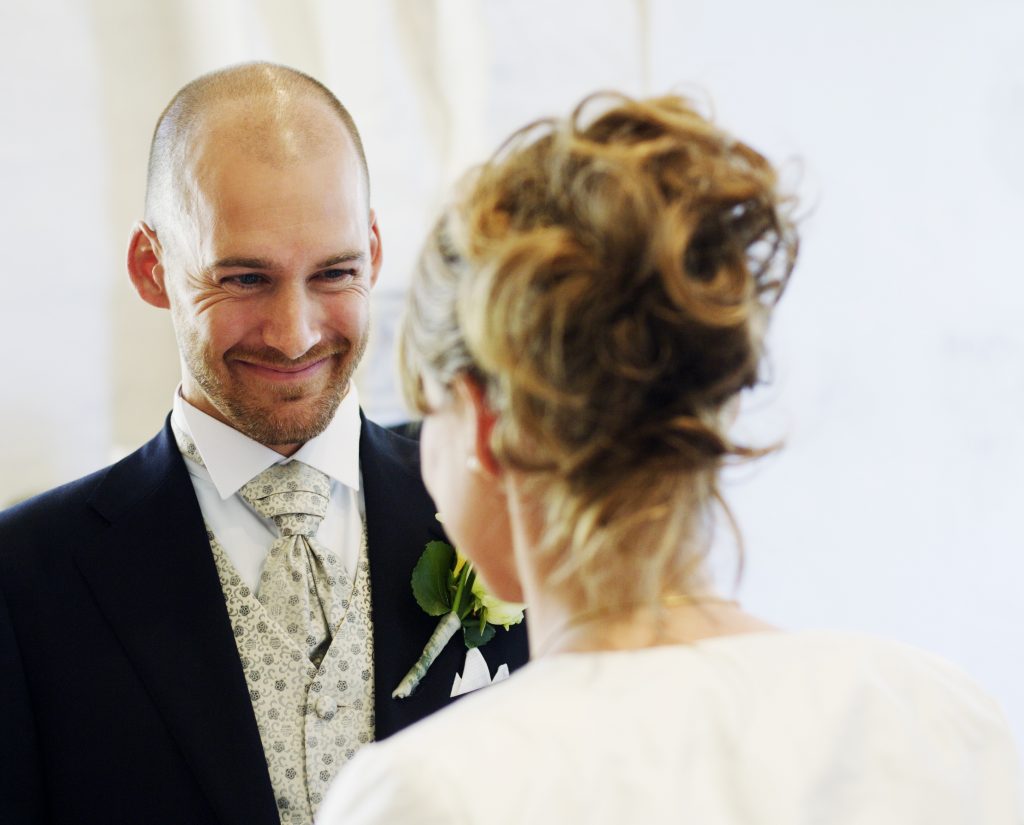
If you’re the one in the relationship who finds this harder to start, you’re not unusual. A lot of grooms feel like they’re supposed to be less expressive, or that their vows won’t measure up.
They will. The bar isn’t eloquence. It’s honesty.
Start with one specific memory and one real promise. That’s it. Everything else builds from there. The vows for a groom don’t need to be long or poetic. They just need to be true.
What personal vows actually sound like
To make this concrete, here’s the difference between generic and specific in practice.
Generic: “I promise to love you unconditionally and always be your support.”
Specific: “I promise to show up on the hard days, not just the easy ones. The days when you don’t feel like talking, and the ones when you can’t stop. I’ll be there for both.”
Generic: “You make me so happy and I can’t imagine life without you.”
Specific: “I didn’t expect to fall in love with someone who makes me laugh harder than anyone I’ve ever met, and then turns around and asks the most thoughtful question in the room. But here I am.”
For a lighter tone:
“I promise to take the dog out on cold mornings. I promise to let you win the playlist argument at least half the time. And I promise to love you in all the ordinary ways that nobody else will ever see.”
Notice what these have in common: they’re specific, they sound like real people, and they make a promise. That’s the whole formula.
The logistics you shouldn’t skip
A few practical things that can save you real stress:
Talk to your partner before you write. Agree on tone (serious, funny, or mixed) and length. There’s nothing more awkward than one person delivering a heartfelt five-minute speech and the other wrapping up in 45 seconds. You don’t need to share the content, just align on the format.
Start at least a month out. Not because it takes that long to write, but because you need time to come back to it with fresh eyes and make edits without pressure. Starting two weeks out is fine. Starting the night before is not.
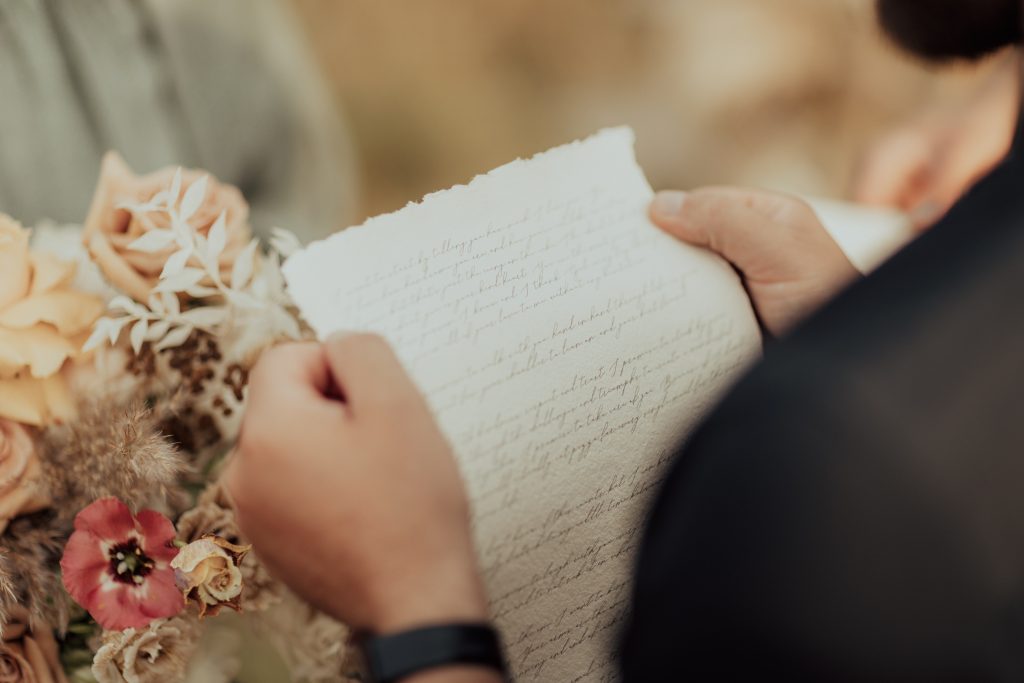
Bring a physical copy. Write or print your vows on paper, not your phone. Print it in a large, readable font. Nerves, happy tears, and an unexpected glare on a screen are all reasons you’ll thank yourself later. Give a backup copy to your maid of honor, best man, or officiant the night before.
Practice out loud. Not to memorize, just to get comfortable with how the words feel in your mouth. Three to five read-throughs before the day is enough.
Check with your officiant. Some religious ceremonies have required language. Some venues have time limits. Know your constraints before you finalize anything.
When you exchange wedding vows, you’re doing something most people only get to do once. You’re telling the person you love, in your own words, in front of everyone who matters, exactly what you’re choosing and why.
That’s worth getting right. Not perfect—right. Because perfect vows don’t exist. Honest ones do.
Here’s a dedicated closing section for the wedding vows article:
Don’t forget about the words your people want to say
Your vows are two minutes of your wedding day. You’ll say them once, out loud, to the person you’re marrying, and they’ll mean everything in that moment.
But here’s what doesn’t get said: the rest of it.
Your best friend who’s been watching your relationship since the beginning and has a story she’s been waiting years to tell.
Your dad, who’s been practicing what he wants to say in the car on the way over.
Your college roommate who flew in and could talk about you for an hour if anyone handed him a mic.
Most of them won’t get one. A wedding toast gives two or three people a few minutes each. Everyone else sits and listens.
That’s the gap The Toast was built to fill.
The Toast is a professionally edited wedding video keepsake made entirely from messages recorded by your guests—before the wedding, on the day, or both. We handle everything: setting up your event, collecting messages from the people on your list, and editing them into a finished video you’ll actually come back to. Not once. Ten years from now, on an anniversary, on a day when you need a reminder of how loved you are.
It’s not ceremony footage. It’s not a highlight reel. It’s your grandmother’s voice. Your best friend stumbling over her words because she means every one of them. Your college friends trying to be funny and accidentally being sincere. The things people say when they’re given a quiet moment and a simple prompt—and when nobody’s watching the clock.
Your vows are yours to write. The voices of the people who love you? Those are worth capturing too.
Still in the thick of wedding planning? Read our ultimate planning guide for more tips and things to consider!