Here’s what usually happens. You’ve been asked to give a wedding speech, you’ve been putting it off for weeks, and eventually you open ChatGPT and type something like “write a best man speech for my friend Jake who is marrying Emma.”
A few seconds later, you have 300 words of clean, readable, completely hollow text. Jake lights up every room. Emma is his perfect match. You couldn’t be happier for them both.
You read it. It’s not wrong, exactly. It just sounds like it was written about no one in particular, which is basically what happened.
Here’s the thing: that’s not a ChatGPT problem. It’s a prompt problem. The tool gave you exactly what you gave it, which was nothing specific. Fix the input, and the output changes completely. This guide shows you how.
Why AI wedding speeches sound the way they do

When you give ChatGPT, or any LLM/AI platform for that matter, a vague request, it falls back on the most common, safe language it was trained on. It’s not broken. It’s just predicting the most likely words for the context you gave it. And the most likely words for “write a wedding speech” are the ones that appear in thousands of other wedding speeches: generic, warm, inoffensive, forgettable.
That’s why every unguided AI-assisted wedding speech contains the same handful of phrases. “You light up every room.” “I couldn’t be happier for you both.” “You are my rock, my safe place, my everything.” They’re not bad sentences. They’re just not about anyone in particular.
A few patterns that immediately signal an AI-written speech:
- Sentences that could apply to any couple at any wedding.
- Clichés used as filler because there are no real stories to anchor the speech.
- The same sentiment repeated three ways in a row: “you are my best friend, my rock, my safe place” (without adding anything new).
- And the complete absence of a story only one person could tell.
If it could be anyone’s speech, it’s no one’s speech.
What ChatGPT is actually good at (and what it isn’t)
Before getting into the how-to, it helps to be clear about what you’re working with.
ChatGPT is genuinely useful for: getting past the blank page, building a clear structure, smoothing transitions between sections, suggesting opening lines, editing a draft for flow, and rewriting sections that feel stiff or too formal.
ChatGPT cannot: know what actually happened between you and the couple, capture your specific voice without help, invent humor that lands without real material, or generate specific details that make a speech feel real.
The right way to think about it: ChatGPT is the scaffolding. Your stories and your voice are the building. Use it as a first-draft partner and an editor. Not a ghostwriter working from nothing.
Before you open ChatGPT, do this first

This is the step most people skip, and it’s exactly why their prompts produce generic results. You can’t get specific output from vague input. Before you type a single prompt, gather the following:
Your role and relationship. Are you the best man, maid of honor, parent, close friend? How long have you known them? What does that relationship actually look like day to day?
One specific story. Not a general impression. A moment. Where were you? When did it happen? What exactly happened, and why does it matter? The more concrete the better.
Real personality traits with examples behind them. Not “she’s generous.” Something like: “She once took a full day off work and drove three hours just because I sounded sad on the phone.” That’s the same quality shown rather than stated, and it gives ChatGPT something to work with.
What you love about the couple together. A specific observation, something you’ve actually witnessed, not a generic compliment about how they balance each other.
Tone and length. Do you want funny, heartfelt, or both? If both, roughly in what proportion? How many minutes when read aloud?
Things you don’t want. Specific phrases to avoid, topics that are off-limits, a tone you’re not going for.
A few sentences in your own voice. Write two or three sentences the way you’d actually talk. Don’t edit them. These become your voice reference.
Think of this as building a brief. The quality of everything ChatGPT produces afterward is a direct function of how specific this input is.
How to actually prompt ChatGPT
Step 1: Assign a role before you ask for anything
Don’t open with “write a wedding speech.” The first thing you do is tell ChatGPT what it’s acting as.
“You are a professional wedding speechwriter who specializes in warm, personal, and genuinely funny toasts.”
That one change shifts the register of everything that follows. It’s a small prompt adjustment with a noticeable impact on output quality.
An even better move: ask it to interview you before writing. Try this prompt:
“You’re a professional speechwriter preparing to write a 3-minute best man speech. What 10 questions would you need me to answer first to write something personal and specific?”
Let it extract the information from you rather than trying to dump everything at once. This mirrors how real speechwriters actually work—asking questions to surface the material before drafting anything. The output from this approach is consistently better than a single block-of-text prompt.
Step 2: Feed it the details you prepared
Once you have your prep notes, give ChatGPT everything. The more specific, the better. Here’s the difference in practice:
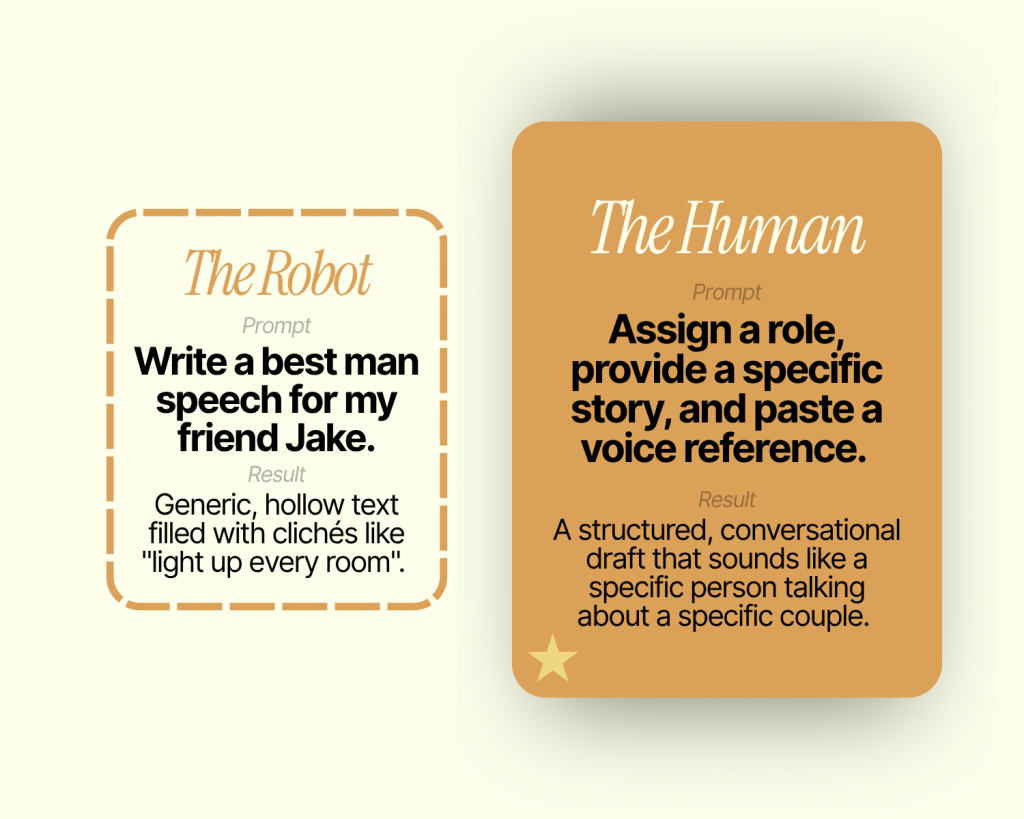
Weak prompt: “Write a maid of honor speech for my best friend Sarah who is marrying Tom.”
Strong prompt: “You are a professional wedding speechwriter. Write a 2.5-minute maid of honor speech for my best friend Sarah, who is marrying Tom. I’ve known Sarah since we were 11. She is stubbornly loyal. She once drove four hours just to be there when I got bad news, without me even asking. She met Tom at a trivia night three years ago, and I knew something was different because she texted me immediately after, which she almost never does. Tom is quieter than Sarah but he keeps up with her energy in a way nobody else can.
The tone should be mostly warm with one genuinely funny moment, not a roast. Avoid phrases like ‘words can’t express,’ ‘you light up every room,’ ‘my rock,’ and ‘I couldn’t be happier for you.’ Write conversationally, not formally. Here’s how I naturally write: [paste two to three sentences in your own voice].”
The second prompt produces something usable. The first produces something you’d delete.
Step 3: Build it in sections, not all at once
Rather than requesting the full wedding speech in one go, ask for an outline first. Review the structure before any drafting happens. Does the order make sense? Is there a section you’d cut or add? Adjust it before you write a word.
Then draft section by section. Ask for the opening separately from the story, the story separately from the close. This gives you more control and consistently better results than a single “give me the whole thing” request.
Step 4: Tell it what you don’t want
Negative instructions often work better than positive ones. Explicitly listing what to avoid actively steers ChatGPT away from the filler it defaults to.
Try adding something like this to any prompt: “Avoid any phrase that could appear in a speech about a different couple. Don’t use clichés like ‘through thick and thin,’ ‘my everything,’ ‘love knows no bounds,’ or anything that sounds like it came from a greeting card.”
You’d be surprised how much this cleans up the output.
Step 5: Treat it like a conversation, not a one-shot request
ChatGPT prompts aren’t a single transaction. If a section sounds off, say so directly and specifically.
“This paragraph sounds too formal. Rewrite it like I’m talking to my best friend.”
“That opening joke doesn’t land. Write three different versions and I’ll choose one.”
“The ending feels generic. Give me five alternative closing lines.”
“The whole thing is about the bride. Add two genuine observations about the groom.”
Every follow-up is another chance to make it better. Most people stop after the first draft. The people whose AI-assisted speeches actually land keep going.
The editing step you can’t skip

Whatever ChatGPT produces, it needs real editing before it’s yours. The AI gave you a starting point. Now you make it human.
Read it out loud. Every time. This is non-negotiable. Words that look fine on a screen often feel stiff or unnatural when spoken aloud. If you stumble on a phrase, rewrite it. If something doesn’t sound like something you’d actually say, cut it.
Then work through these questions:
- Does this sound like me, or does it sound like a speech written about me by someone who’s never met me?
- Is there at least one story that only I could tell?
- Are there any lines that could be copied and dropped into a speech about a completely different couple?
- Would the couple actually recognize my voice in this?
Replace anything that sounds like a Pinterest board. Add the specific detail ChatGPT didn’t have: the actual name of the bar where they met, the exact way she laughs, the inside reference that only makes sense with one sentence of context. Cut anything that’s padding.
If a sentence doesn’t earn its place, it goes.
| 💡 A quick note on whether it’s okay to use AI for this: Some people feel strange about it. That’s understandable. But professional speechwriters have always existed. Having help with expression doesn’t make the feelings less real. The love you have for the couple is yours. The memories are yours. The stories are yours. ChatGPT just helps you turn all of that into a structured, speakable draft. The test isn’t whether you used AI. It’s whether the final result sounds like you and means something. If you spent real time feeding it real details and edited the result honestly—adding what only you could add, cutting what doesn’t belong—it’s yours. If you copy-pasted the first draft unread and hoped for the best, that’ll show. |
What ChatGPT can’t give the couple
ChatGPT can help you shape a speech. But the raw material? The real stories, the specific memories, the observations that only come from actually knowing someone… that has to come from you. No prompt can generate that. No tool can invent it.
You have something nobody else at that wedding has: your version of this couple. The way you’ve seen them show up for each other. The story that came to mind immediately when you were asked to speak. The thing you know about them that didn’t make it into the final draft.
Most of the other guests in that room have a version of that too. They just won’t get the chance to say it out loud. If you want to give the couple something that goes beyond your speech, tell them about The Toast.
It’s a professionally edited wedding video keepsake made from messages recorded by their guests, the people who’d never ask for a microphone but absolutely have something worth saying. Simple prompts, a phone camera, and we handle the rest.
The couple ends up with something they’ll come back to long after the wedding day fades. Everyone’s version, not just yours.