Wedding attire planning often starts with the dress and works outward from there. But what the groom and wedding party wear sets the visual tone just as much, and it involves its own set of decisions: color, silhouette, lapel style, fabric, and whether to rent or buy.
The right wedding tuxedo isn’t just about looking formal. It’s about looking intentional: like the whole day was thought through, not assembled the night before. This guide covers everything from the difference between a tux and a suit to specific color and style recommendations by season and venue, plus a practical timeline for ordering.
Tuxedo vs. suit: What actually separates them?
Before choosing colors or lapel cuts, it helps to understand what makes a tuxedo a tuxedo. The distinction is more than formality level.
| Feature | Wedding tuxedo | Wedding suit |
|---|---|---|
| Lapels | Satin-faced: the defining visual signature | Same fabric as the jacket, matte finish |
| Buttons | Satin-covered | Standard fabric-covered or metal |
| Trouser stripe | Satin stripe down the outseam | No stripe |
| Formality | Black tie and formal evening events | Semi-formal to daytime events |
| Traditional shirt | Wing-collar or turn-down tuxedo shirt | Standard dress shirt |
| Neckwear | Black silk bow tie (traditional) | Tie, bow tie, or open collar |
The practical upshot: if your invitation says black tie, wear a tuxedo. If it says cocktail attire or is a daytime outdoor event, a suit is appropriate and often more comfortable. If it says black tie optional, a tuxedo is the safest choice and always the right one if you’re the groom.
The core tuxedo elements to understand
Lapels
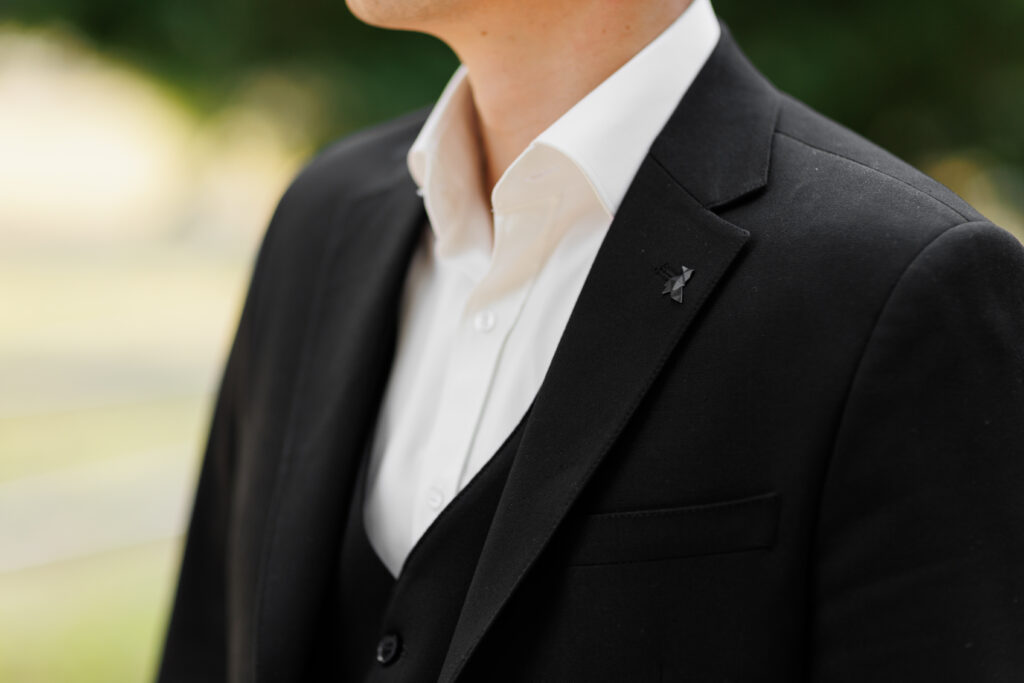
The lapel is the single most important design decision on a tuxedo. It frames the face, communicates formality, and defines how the jacket photographs.
Peak lapel: The most formal and commanding option. The edges point upward toward the shoulders, drawing the eye up and creating the effect of broader shoulders and a narrower waist. A peak lapel reads powerfully in wedding photos and is a top choice for formal venues.
Shawl lapel: A smooth, continuous curve with no break or notch. Sleek, elegant, and red-carpet in energy. Works particularly well with velvet jackets and classic black tuxedos. Distinguishes the groom from groomsmen wearing simpler lapels.
Notch lapel: The most common lapel on everyday business suits. The least formal option for a tuxedo. It can work at semi-formal or “black tie optional” weddings, but at a formal or black-tie event, peak or shawl will always look sharper.
Fit
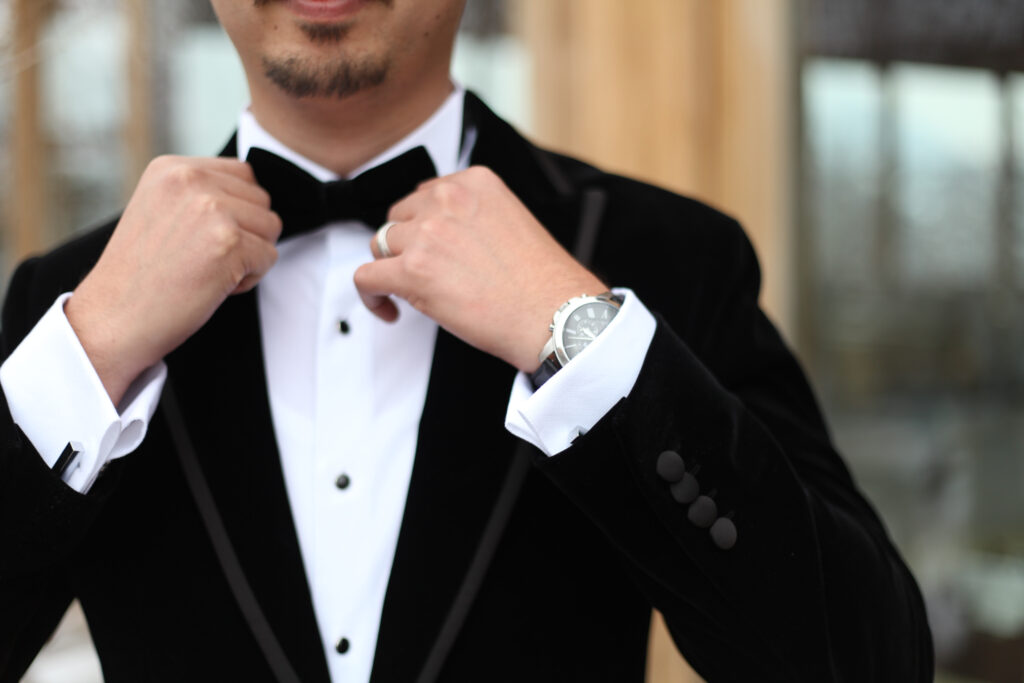
Fit matters more than any single design decision. A well-fitted $500 tuxedo photographs better than a poorly fitted $2,000 one. Look for shoulders that sit cleanly, a jacket that tapers gently through the waist, trouser hems that break just above the shoe, and sleeves that show a quarter inch of shirt cuff.
Slim and modern fits work well for most builds and read especially cleanly on camera. Classic cuts provide more comfort and suit larger builds. If you’re between sizes, lean toward the closer fit and tailor in, since removing fabric is easier than adding it.
Waist coverage
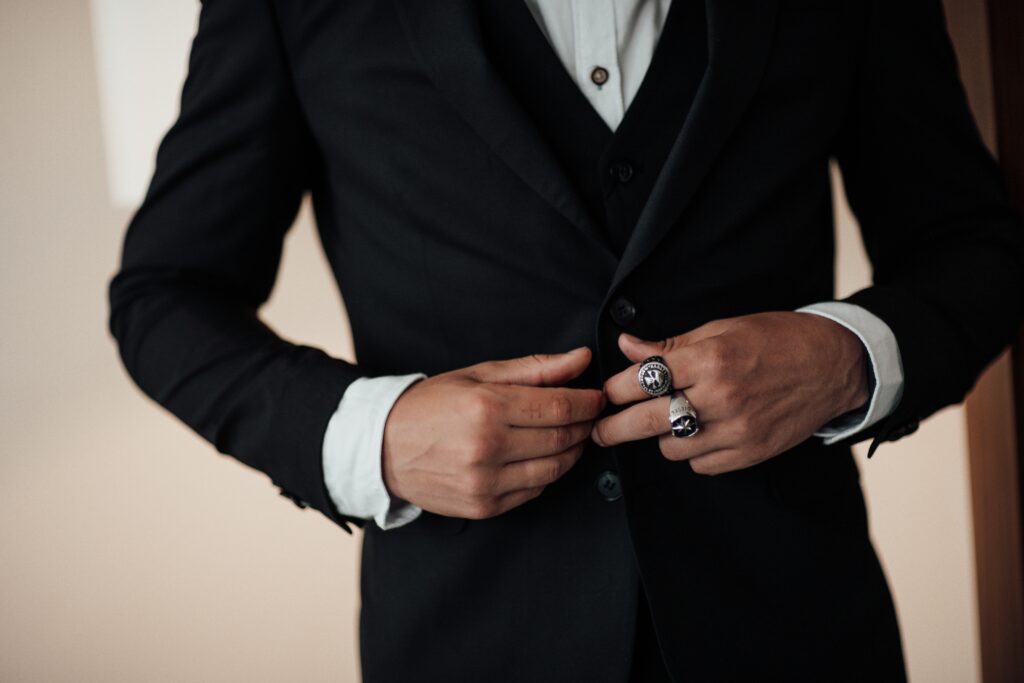
A cummerbund or waistcoat covers the waistband between the jacket and trousers for a clean, finished look, especially when the jacket is removed. A low-cut vest looks particularly modern in 2026 and frames the shirt studs well. A cummerbund is more traditional and works well in warm climates where a vest might be too warm.
Tuxedo colors and what they work best for
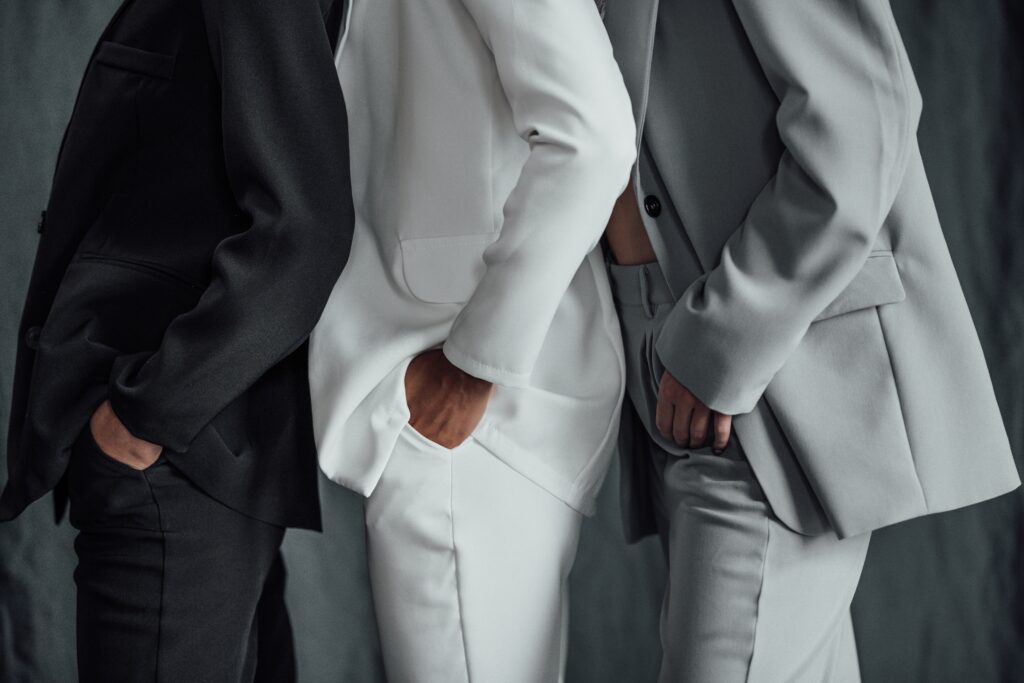
Classic black: The gold standard for evening weddings, ballrooms, formal venues, and black-tie events. A well-tailored black tuxedo with a peak or shawl lapel and a white tuxedo shirt is essentially impossible to get wrong. The most popular groom tuxedo choice and consistently the easiest to coordinate with wedding party attire.
Midnight blue: The strongest alternative to black in 2026. Photographs rich and deep, often richer than black under certain lighting, while giving a sense of modern personality that a standard black tuxedo doesn’t. A midnight blue tuxedo with black satin lapels is one of the most effective groom tuxedo ideas for couples who want something slightly unexpected without straying from formality.
Cream or ivory: Best for warm-weather climates, outdoor country club settings, destination weddings, and beach ceremonies. A cream tuxedo or ivory dinner jacket is typically paired with black trousers and a black bow tie for contrast, a highly photogenic combination. The key is choosing a warm ivory or cream shade rather than stark white, which can read clinical under flash photography. A cream colored wedding tuxedo works especially well at summer and destination events.
Deep jewel tones (burgundy, emerald, deep green): Trending for 2026, particularly for fall and winter weddings. Pairs well with richer color palettes and distinctive enough to make the groom stand out from groomsmen without abandoning formality.
Charcoal: A strong choice for daytime weddings, outdoor settings, and semi-formal events where a full black tuxedo might feel too heavy. More versatile than black across seasons and venues.
Black and white: The classic wedding tuxedos black and white combination (black tuxedo with a white shirt, or an ivory dinner jacket with black trousers) remains one of the most timeless and photogenic options for any level of formality.
Matching your tuxedo to your venue and season
| Venue / season | What works well | What to avoid |
|---|---|---|
| Formal ballroom / black tie | Classic black or midnight blue, peak or shawl lapel, satin details | Notch lapels, matte fabrics, linen or linen blends |
| Outdoor garden / daytime | Navy, charcoal, grey suit, cream dinner jacket | Heavy structured tuxedos in hot weather |
| Summer outdoor | Cream or ivory dinner jacket, linen suit, lightweight navy | Dark heavy fabrics that absorb heat |
| Fall indoor / barn | Deep navy, burgundy, charcoal, earthy tones | Very pale colors that don’t read against autumn foliage |
| Winter formal | Black tuxedo, velvet dinner jacket, midnight blue | Light colors or fabrics too casual for the setting |
| Beach / destination | Linen suit, lightweight cream, casual separates | Full traditional tuxedo in heat or on sand |
A note on the summer wedding tuxedo: for outdoor ceremonies in warm weather, comfort matters as much as aesthetics. Lightweight wool, fresco fabric, or linen-blend suiting in navy or cream tends to perform better than a traditional tuxedo in heat. Save the full formal tux for the evening reception if the ceremony is outdoors in summer.
For winter wedding tuxedos, velvet dinner jackets are having a strong moment and look particularly striking in candlelit indoor settings. A velvet shawl lapel jacket in black or deep jewel tones is one of the most distinctive winter wedding tuxedo looks available right now.
Should the groom’s tuxedo match the groomsmen?
Not necessarily, and most style experts recommend against it. The groom should stand out, not dramatically, but clearly. A few ways to create distinction without disrupting cohesion:
A different lapel style (peak for the groom, notch or shawl for groomsmen). A unique jacket color while groomsmen wear a complementary tone. A different fabric: velvet or textured jacquard for the groom, standard wool for the wedding party. Distinct accessories: a boutonniere, a different pocket square, or unique cufflinks.
The goal is coordination, not matching. Groomsmen should complement the groom’s look, not replicate it.
Rent or buy: What to consider?
For most grooms, the decision comes down to how often you’ll realistically wear a tuxedo again. Renting gives you access to current styles at a lower upfront cost and is often the most practical choice for a single event. Buying makes more sense if you attend multiple formal events per year, want a custom or made-to-measure fit, or want to invest in a piece you’ll wear for decades.
If you do buy, the cost of a quality tuxedo starts at around $400 to $600 for a solid off-the-rack option, with tailoring adding $100 to $300. Custom tuxedos for weddings from a made-to-measure service typically run $800 to $2,000 depending on the fabric and details, but result in a fit that off-the-rack can’t match. The tailoring cost alone often closes the gap between buying and renting.
For couples looking at cheap tuxedos to keep the overall budget down: rental is usually the smartest route. Services like Generation Tux, The Black Tux, and Friar Tux offer well-maintained current-style rentals delivered to your door with a return label included. Tuxedo stores with in-house rental programs often allow the full wedding party to get measured locally, which simplifies coordination across different cities.
The ordering and fitting timeline
Wedding attire for multiple people across different cities takes more lead time than most grooms expect. Here’s a realistic timeline:
6 to 8 months out: Decide on the look and start talking to rental services or tailors. If going custom, this is when to start, as custom tuxedos for weddings typically require 3 to 4 months of production time.
4 to 5 months out: Have all groomsmen submit measurements, especially those in different cities. Most rental services have an online measurement process; custom tailors will need in-person appointments.
2 to 3 months out: Confirm your order and any customizations. Lock in accessories: shirt, bow tie, cufflinks, pocket square, and shoes.
2 weeks out: Full fitting check with the complete outfit, including shoes, socks, and cufflinks. This is your last window for alterations before the wedding.
Wedding day: Steam or press the jackets the morning of. Pack a small kit: double-sided tape, a safety pin, and a lint roller. Wrinkles and lapel pins that won’t stay put are the most common last-minute problems.
One more thing worth planning for
The tuxedo is what photographs. But after the wedding, when the album is printed and the suit is returned, what couples come back to are the voices: the best man’s toast, the groomsmen’s messages, your dad trying and failing to hold it together.
That’s what The Toast captures. While your photographer documents how everyone looks, we handle the voices of the people who showed up for you: video messages recorded from anywhere, before or during the wedding, professionally edited into a keepsake you’ll watch for years after the honeymoon ends.
The tuxedo is for the day. The Toast is for everything after it.
Book a free discovery call and we’ll show you what a finished keepsake looks like.